
Items
Tag
Monocular
-

Monocular Compound Microscope
The compound microscope is made from lacquered brass and the Y-shaped foot is permanently attached to a mahogany platform. The monocular microscope has a mechanical stage which can be adjusted along a X and Y axis via two thumbscrews. One of the thumbscrews moves the stage horizontally; however, the vertical adjustment no longer works due to a hole in the adjustment gear. The coarse focusing is achieved via a rack and pinion mechanism which moves the body-tube closer or further away from the fixed square stage. Fine focusing functions via a thumbscrew located at the bottom of the body-tube. The stage has two holes on either side of the corners which can hold accessories such as stage forceps or bullseye condenser, however, no accessories come with the microscope. The sub-stage concave mirror is one-sided and is attached to the pillar. The style of the microscope is similar to the Robert Fields' 1855 Society of the Arts winning design. The fitted mahogany case is original to the microscope, which has a brass carry handle on the top of the case. The interior has 5 circular sections to hold the objectives and ocular lenses that come with the microscope. There is a small draw located in the top of the interior which holds slides. The keyhole escutcheon matches that of other Beck microscope images, so it may be by produced by R & J Beck. -

R & J Beck Compound Microscope
The R & J Beck's compound microscope is made from lacquered brass with a continental horseshoe base which is solid brass and has etched "R & J. Beck. Ltd London 26669" into the back of the base. On one of the sides of the base, "WILLIAMS BROWN & EARLE PHILADELPHIA" is etched into the foot. The substage double-sided mirror — which includes a concave side — is attached via a gimbal arm to a swinging tailpiece that is connected to the pillar. The square, mechanical stage is painted black and has two metal clips to secure a specimen. There are two holes on both corners of the stage in which accessories such as stage forceps can be attached. However, there are not any stage accessories with this microscope. There is also a substage iris diaphragm that can be adjusted via a lever on the outside. The coarse focusing functions via a rack and pinion mechanism which moves the body tube closer or further away from the fixed stage. The fine focusing mechanism is controlled by a thumbscrew located at the top of the pillar. The fitted case is original to the microscope and has compartments on the inside of the door that hold the objectives and ocular lenses. The case has a brass carry handle on top of the microscope and the case is secured with a lock; however, there is not a key with the microscope. -

Charles Baker Compound Microscope
The compound microscope is made from lacquered brass. The microscope is supported by a straight-legged tripod with the substage double-sided mirror connected to the pillar in between the legs of the tripod. The substage plano-concave mirror is secured to a gimbal support which allows for adjustment to catch the light. The circular stage can be rotated and has two brass spring clips which hold the specimen in place for observation. There is also an Abbe substage condenser which has an adjustable iris diaphragm which can be altered with a lever along its side. The coarse focusing functions via a rack and pinion mechanism which moves the body-tube closer or further away from the fixed stage. The fine focusing mechanism is controlled by a thumbscrew located at the top of the pillar. The pillar has the words "Baker, 244 High Holborn, London." etched into the brass. The microscope comes with its original mahogany case and has interior compartments for the accessories and separate bullseye condenser. The case has a brass carry handle located on its top and the lock is still fitted; however, a key did not come with the microscope. -

J. Swift & Sons Histological Compound Microscope
The compound microscope is signed "J. Swift & Son. London. Patent 24960" on the base and the initial design was for Histology (the study of tissues.) The serial number "1275" is shown on Traviss-type mechanical stage. The base has four legs, with the back two on a swivel hinge so that it can collapse to fit inside the case. The draw-tube has a triple objective nose piece that revolves when needed. Coarse focusing functions via a rack and pinion mechanism that moves the body-tube closer or further from the mechanical stage. The thumbscrew on the top of the limb controls the fine focusing. The square stage measures 3.75" with engraved grid on surface. The stage has a sliding mechanism to position and secure the specimen. The sub-stage Abbe condenser has a iris diaphragm that functions via a rack & pinion vertical adjust. The dia plano-concave mirror is fixed onto a universal mount. The microscope comes with a fitted mahogany case with brass key and fittings. The interior of the case has compartments to hold the objectives and parts of the dismantled microscope. -

Compound "Zentmayer" Style Microscope
The compound microscope is made of lacquered brass and mounted on a japanned black cast iron horseshoe base. The main body tube is mounted on top of a four-inch brass pillar via a compass joint which allows the complete optical assembly to tilt over a range of 90 degrees. There is an inner sliding body tube extender which increases the body length by up to 3 inches. A removable substage condenser has an adjustable diaphragm opening (20 mm max.) The circular specimen stage is engraved "Betz Special, Chicago, Illinois" and has a substage diaphragm located underneath the stage. Many of the Betz microscope components were apparently manufactured by the Gundlach Manhattan Optical Company and some of the Betz microscopes were delivered with Zeiss lenses. The microscope comes with its original hardwood carrying case. It has an interior draw that holds the accessories. The case is secured by a brass swing hook on the side of the case and has a brass carry handle. -

Charles Baker "Ross Type" Microscope
The Charles Baker compound microscope comes with the original mahogany case. The brass microscope can be dissembled to fit into the case. The body tube and arm are secured via a thumbscrew to the mahogany platform which is fixed to the claw-footed base of the microscope. The lacquered brass foot has "BAKER, 244 High Holborn, LONDON" carved into it. The body tube and arm can then be attached via a screw to the pillar of the microscope. The fixed square stage is attached to the pillar and has a square fixture that can be horizontal to adjust the specimen. There is a substage revolving diaphragms that can be removed via a sliding mechanism. Coarse focusing functions via a rack and pinion mechanism and fine focusing is operated via thumbscrew found on the arm. The substage, one-sided mirror is permanently attached to the pillar of the microscope via a gimbal. The mahogany case is farcened with a brass lock which is no longer present on the case with the escutcheon missing. The wooden fitting that would originally have held the two objectives in the case is half missing and so the accessories are now being held in the draw located at the bottom of the case. The draw has a brass pull loop to open and close it. The case also has a brass handle at the top that is used to carry the case. -

Drum Compound Microscope
The drum compound microscope is made of brass. The style was manufactured in France, Germany and England and sold throughout the United States and Europe. Many of the microscopes manufactured using this design were unsigned due to the huge quantities sold by various makers. The microscope consists of a body-tube suspended by a tubular base above a circular specimen platform. Coarse focus functions by moving the body-tube closer or further away from the specimen platform via a sliding mechanism operated by a thumbscrew. There is also a concave sub-stage mirror located at the bottom of the microscope. The "coffin-style" mahogany case has compartments for the microscope, slides and accessories. There was a small, decorative plaque on the top of the lid, however, it is no longer attached to the case. The case is secured via a lock and key; however, the key is not present with the microscope. -
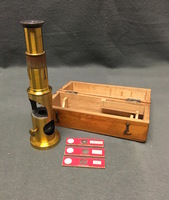
Drum Compound Microscope
The drum compound microscope is made from lacquered brass. The style was manufactured in France, Germany and England and sold throughout the United States and Europe. Many of the microscopes manufactured using this design were unsigned due to the huge quantities sold by various makers. The microscope consists of a body tube suspended by a tubular base above a circular specimen platform. The body tube is moved closer or further away from the specimen platform to coarse focus via a sliding mechanism. There is also a concave substage mirror located in the bottom of the microscope, which can be seen through a circular cut out. The "coffin-style" wooden case has compartment for the microscope and slides. The case is secured with two swing hooks. The microscope comes with the following accessories: 3 cardboard prepared slides. -

Simple "West Patent London" Microscope
Many simple microscopes were made around the 19th century to the style of the "Society of Arts" Prize Pattern. Many used this design to create affordable microscopes, therefore very few were signed by the creator and the design differed depending on the manufacturer. The "Cary-Gould" style, simple microscope is made from lacquered brass and is case-mounted onto a fitted mahogany case. The pillar screws into the top of the lid which is permanently attached to the circular stage and arm. The objective lens can be used separately — to work as a simple microscope — or used together to function as a compound microscope. The sub-stage mirror is attached via a pin into the lower part of the pillar. The dissecting pin is attached via a pin to the stage. The mahogany fitted case is secured by two brass hooks on either side of the case. The interior of the case is lined with blue velvet and is organized into compartments to fit the disassembled microscope. -

Botanical "School" Microscope
The botanical entomological microscope consists of a brass tubular pillar stand that screws into the lid of the wooden case. At the top of the pillar is a fixed arm that holds the three stacking objectives that can be used together or individually. The round black stage with slide clips elevates up and down the pillar manually simply by lifting it up and down the pillar as desired. The gimbaled sub-stage mirror is attached to the lower pillar. The design was often called a "School Microscope" because it could be used for educational purposes such as particular examination of botanical specimens, small insects or insect parts, water fleas and other objects that could be readily collected and examined. This instrument is an English import and follows the design of the Society of Arts School Microscope of the 1855 time period. The design is similar to the earlier model of the Ellis Aquatic microscopes. It was also considered an inexpensive, simple microscope and became a popular model. The wooden case is secured by two swinging brass hooks. -
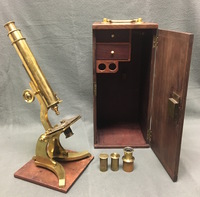
White and Barr Microscope
The compound monocular microscope is made from lacquered brass and mounted on trunnions. The microscope has a Y-shaped base which is mounted on a wooden platform. The microscope has coarse focusing via rack and pinion which is controlled by a thumbscrew located on the side of the support pillar. The support pillar is connected to the body-tube and the square stage is fixed. A polarizer is screwed into the bottom of the stage; however, there is no substage mirror present on the microscope. The fitted mahogany case has a brass carry handle. The two interior accessories drawers have ivory handles and there are two circular wooden cutouts to hold the objective canisters. The case has a functional lock but no key is present with the microscope. -

Drum Compound Microscope
The drum compound is made of lacquered brass. This style was manufactured in France, Germany and England and sold throughout the United States and Europe. Many of the microscopes manufactured using this design were unsigned due to the huge quantities sold by various makers. The microscope consists of a body tube suspended by a tubular base above a circular specimen platform. Coarse focusing is achieved via a sliding mechanism in which the body tube is moved closer or further away from the specimen platform. A bullseye condenser is attached to the front of the microscope which can be adjusted via the double-jointed arm. There is also a concave substage mirror located in the bottom of the microscope, which can be seen through a square cut out. The mirror can be adjusted by thumbscrews on either side of the microscope, however, the mirror is detached on one side. The "coffin-style" wooden case has compartment for the microscope and slides. The case is secured with two swing hooks. -

"Cary-Gould style" Field Microscope
The field microscope is made of brass and case-mounted onto a mahogany case which acts as the base. The pillar is secured into the lid of the case via a screw attachment at the bottom of the pillar. The stage is permanently attached to the pillar and coarse focusing functions by a rack and pinion which moves the stage closer or further from the objective. The arm is attached by sliding it into the top section of the pillar where it is secured by a thumbscrew. The objective lens are screwed directly into the end of the body-tube which can then be screwed into the arm. The stage has two clips that hold the specimen by placing the slide between the clip and the square stage. The sub-stage mirror is attached via a pin into the pillar. The mahogany fitted case has some marks and stains. The inside of the case is lined with blue velvet and has compartments to fit the dissembled microscope and accessories. The case is secured by two brass swing hooks on the sides. -
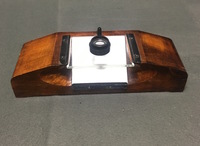
Simple Dissecting Microscope
The dissecting microscope is made of solid mahogany with tapered ends that form rests for the hands. The glass stage plate is beveled with a white glass plate located underneath that is placed at an 45 degree angle for illumination. The lens is held in a fitting which swings over the stage plate and slides up and down for focussing. This microscope style was used mainly to study small flowers and plants as well as small animals. -

"Cary & Gould" style Microscope
The "Cary-Gould type" microscope is a common variation of the design. The design came in three sizes and this microscope is considered a "medium." The microscope has a support pillar that screws into the top of the lid. The body-tube is screwed into the arm of the pillar. This design also allows for the microscope to used as a simple microscope by screwing the objectives directly into the arm. The coarse focusing functions via a rack and pinion mechanism which moves the circular stage closer and further away from the objective lens. The circular stage has a under-stage sprung slot which holds the slide and the specimen forceps are attached via a pin. The sub-stage concave mirror is attached via a pin into the support pillar. The microscope can be used as both a compound and simple microscope depending on whether the body-tube or objectives are used respectively. The fitted mahogany case has purple velour-lined interior. The case is closed via two swing hooks, however, one is missing. -
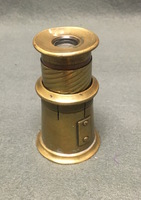
Pocket Magnifier
The pocket focusing magnifier is made of lacquered brass and has an unusual Archimedean screw thread. Focusing is operated by twisting the body-tube along the thread in a circular motion to adjust the distance between the ocular and objective lens. These instruments were commonly composed of two plano-convex lenses of identical focal length, mounted with their plane sides outward at a distance apart equal to two-thirds of the focal length. This instrument would have been used in photography. It could be used to focus on an image by aiming the lens or placing it against an image, therefore not allowing light to enter. -

Drum Compound Microscope
The drum compound microscope is made of lacquered brass. The style was manufactured in France, Germany and England and sold throughout the United States and Europe. Many of the microscopes manufactured using this design were unsigned due to the huge quantities sold by various makers. The microscope consists of a body tube suspended by a tubular base above a specimen platform. The body tube is moved closer or further away from the specimen platform to focus via a sliding mechanism. There is also a concave substage mirror located in the bottom of the microscope, which can be seen through a square cut out. The mirror can be adjusted by thumbscrews on either side of the microscope. The thumbscrew for the rotation of the mirror has the word "France" engraved in it. The fitted case is designed along a "coffin-style" that is secured with two small swing hooks. One of the hinges that holds the top is broken. The case has a small compartment to hold slides or accessories. The inside of the case has a paper plastered on it that reads: "GROSSISSEMENT. 1 lentille....30 fois. -

Cary-Gould style Simple Microscope
The Cary-Gould style microscope is made of lacquered brass. The simple microscope has a circular support pillar that screws into the top of the case, which acts as the base. The coarse focusing is achieved by extending the arm higher or lower via a rack and pinion mechanism. The fixed stage is detachable to fit the microscope into the case and has two stage clips to secure the slides. Unusually, the microscope does not have a substage mirror. The mahogany case is fitted to hold the instrument. The case has sections to hold various accessories, and the inside of the lid is lined with purple velvet. The top of the lid has a brass fixture for the pillar to screw into. The case is secured with two swing clips. -
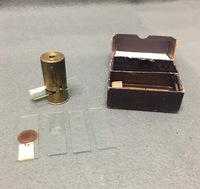
Pocket Handheld Microscope
The pocket simple microscope is made of lacquered brass. The microscope magnifies items 50 times linearly. The design is also known as a "universal" microscope and was popular from the start of the twentieth century. The simple design includes a singular ocular and the slides are held in place via a slot on the lower section of the circular body which is spring-loaded. These types of microscopes were manufactured in France or Germany and due to their low-cost, durability, and simplicity to use meant it was a popular instrument for hobbyists. The original box is made of cardboard and has two compartments to hold the microscope and the slides. The case also has instructions to use the instrument inscribed inside the lid. -

Drum Compound Microscope
The drum compound microscope is made from lacquered brass. The design of the instrument is French and was used by scientists and students in the field as it's compact size made it easy to use outside the laboratory. The focusing is done by moving the draw-tube closer or further away from the fixed circular stage. The substage mirror is one-sided and is plano-concave. The base is weighted in order to balance the microscope. -

Drum Compound Microscope
The drum compound microscope is made from lacquered brass. This design made the microscope easy to use in the field by scientists. The focusing is done by moving the draw-tube closer or further away from the fixed circular stage. The design is French and has a one-sided substage plano-concave mirror located underneath the stage. The base is weighted in order to balance the microscope. -
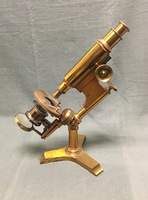
Bausch & Lomb Microscope
The monocular compound microscope has a tripod base with the arm and stage in a cradle joint. The stage revolves, and has two indexed swinging arms below the stage. These arms are dovetailed for the substage condenser, which has a wheel of stops and a swing out holder for a dark field disk (which is present,) and for the concave mirror, which can swing below or above the stage. It has a single nosepiece and on the arm, below the focus knobs, are the patent dates for October 1876 and October 1885. "Bausch & Lomb Optical Co" is engraved on the revolving stage. The microscope has a single draw tube which is nickel plated. This microscope is very similar to number 170 in Billings Collection, noting that it has a single nosepiece and a single draw tube. The case is in serviceable condition, but shows the signs of extensive use. There are cracks on the back, the bottom has a crude repair on the front under the door. The lock is complete and seems to be functional, but the locking tab has been removed from the door and a swinging home made latch secures the door closed instead. The key is present in the drawer in the case. The top handle is missing and there is a picture of a dignified man on a Tennessee Walking Horse pasted on the back inside of the case. -
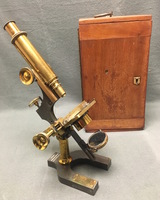
William Watson & Sons Microscope
The microscope is a "Edinburgh Model C" with mechanically stage. The microscope is engraved in block letters on the foot "W. Watson & Sons, 313 High Holborn, London." There is also a serial number "2754" on the side of the base. In addition, it includes a brass plaque attached to the foot, which reads as follows, “PRESENTED TO William Anstey BY HIS MOTHER, BROTHERS & SISTERS. In loving recognition of his untiring devotion TO THE WELFARE OF THE FAMILY, MARCH 1892.” Due to the fact that Watson did not take on this name for the firm until the year 1908, it would appear that the stage was added to this microscope as an accessory sometime after that year. A heavy solid Japanned brass Y-shaped foot supports a solid brass pillar at the top of which is a movable joint that joins the pillar to the stage, which in turn supports the limb of the microscope. This joint just below the stage allows the microscope to be tilted to any comfortable angle for viewing. It has a rack and pinion main focusing system and a thumb wheel micrometer fine focusing system via a spring-loaded lever system extending through the limb. Atop the main stage is a supplemental mechanical stage with dual thumb wheel “X –Y” controls extending to the side. The stage is engraved with the inscription, “W. Watson & Sons, Ltd., London”. The body-tube includes a draw-tube, which is engraved with various tube settings. An eyepiece (unmarked as to magnifying power) is found at the top of the body-tube. Under the stage is a swing-out brass housing for a condenser, but no condenser is present. Also under the stage is an adjustable stem with a nice adjustable plano-concave mirror. The mahogany case is of dovetail construction and is equipped with a brass carrying handle at the top. It accommodates the microscope and there is a wood rack inside the right side of the case that nicely accommodates the mechanical stage. -

"Cary-Gould type" Pocket Microscope
The small case-mounted Cary-Gould style microscope can be fully dissembled to fit into the case. The limb of the compound microscope is permanently connected to the inside of the case. The substage mirror can be attached via pin to the limb. The circular stage is attached to the rack and pinion compartment by a pin and can be focused by moving the stage via the small thumbscrew. The body-tube can be screwed into the arm on the top of limb and is held in place by screwing the objective into the underside of the body-tube attachment. The original fitted mahogany case has a small brass plaque mounted on the top. The case is lined with green velvet and is separated into compartments for the microscope to dissemble and fit. -

Charles Baker Compound Microscope
The brass, compound microscope was designed by the Ross pattern with a Y-shaped foot screwed to a mahogany board which slides into the case. The stand is the Baker #2 stand advertised in 1862. The coarse focusing is operated by rack work and fine focusing by thumb-wheel on the nose-piece. The circular stage has a centering bar that slides along the stage for positioning the specimen. Below the stage is an adjustable Abbe condenser that moves with its own rack work and adjusting thumb screws. The condenser has a slide out holder for filters and the substage mirror is concave and one sided. The microscope has three eye-pieces of different magnification and is signed on the foot "Baker, 244 High Holborn, London." The mahogany case is fitted and has compartments to hold the objectives and slides.